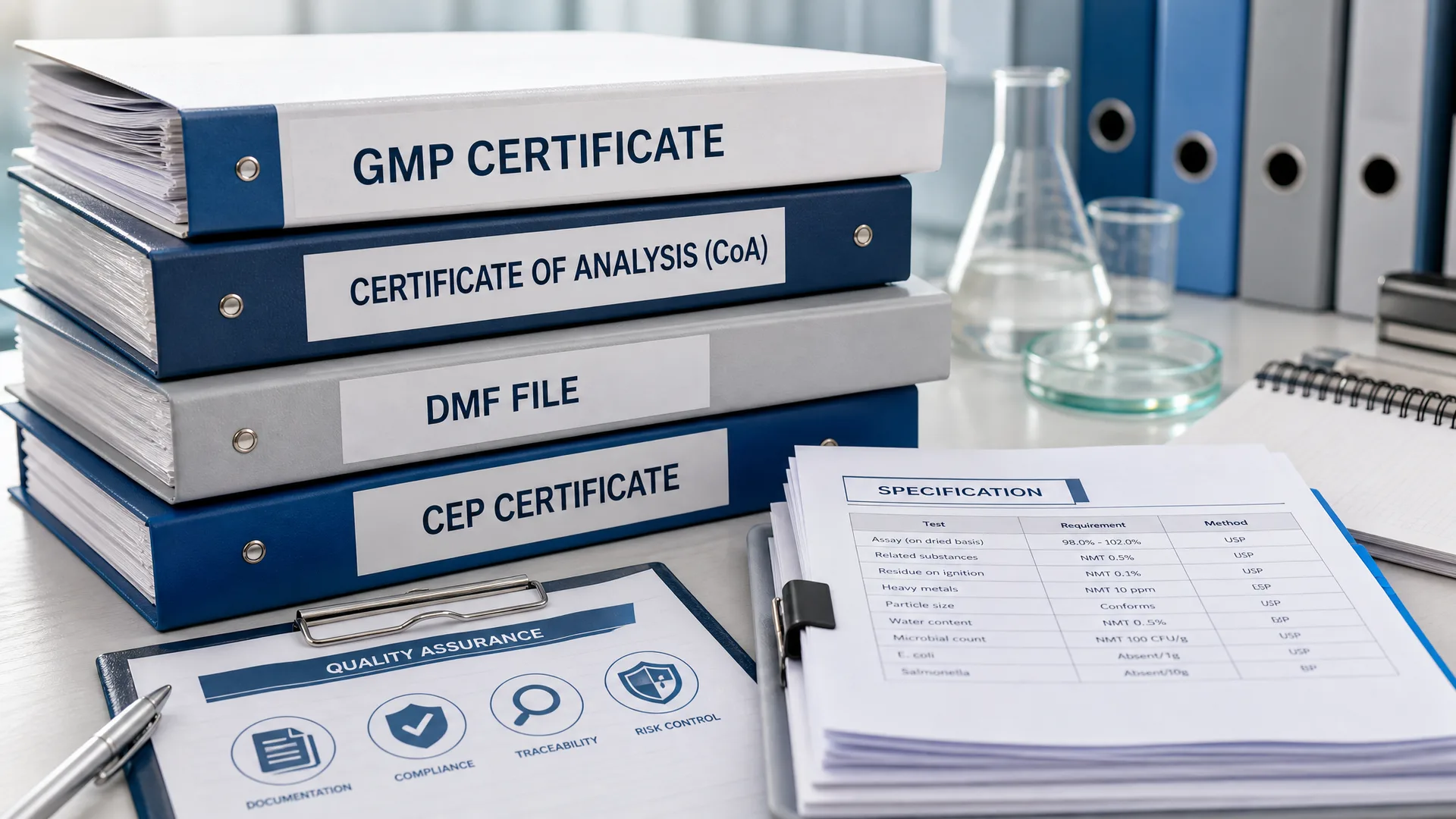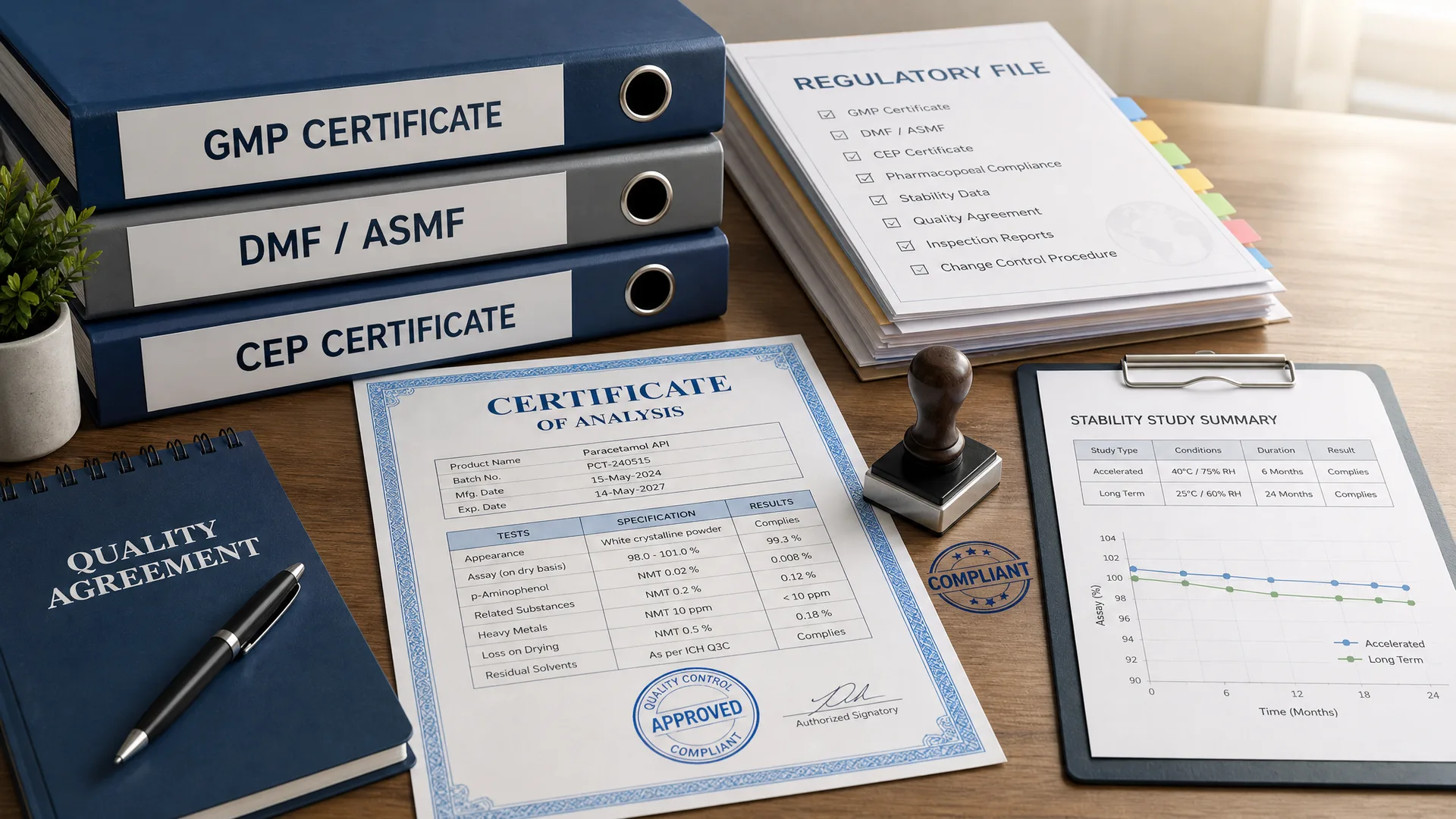
What documents should an API manufacturer provide to buyers?
Every pharmaceutical buyer, whether in procurement, QA, or regulatory affairs, faces the same challenge when evaluating a new API manufacturer: knowing exactly which documents to request, and why each one matters. Incomplete documentation slows supplier qualification, delays regulatory filings, and creates compliance gaps that surface at the worst possible moment. Farmson, a global leader in API manufacturing with over 50 years of experience exporting pharmaceutical APIs to 65+ countries, approaches documentation as a structured qualification tool rather than a paperwork exercise. This guide maps every document an API manufacturer should provide, organized by purpose, so your team can evaluate any supplier systematically.
TL;DR - Summary
- What documents should an API manufacturer provide? - A qualified API manufacturer should supply technical documents (certificate of analysis, specification sheet, impurity profile, stability data), quality and GMP records (GMP certificate, site master file, quality agreement), regulatory filings (DMF, CEP, or ASMF with letter of authorization), traceability records (batch documentation, certificate of origin), and commercial documents (safety data sheet, export documentation). The exact package depends on the destination market and the buyer's regulatory pathway.
- Why does documentation vary by market? - Destination market requirements determine which regulatory filings are needed. A US filing requires a USDMF and letter of authorization, while a European submission needs a CEP or ASMF. WHO prequalified supply routes accept CEP or stringent regulator pathways. Buyers must confirm that the manufacturer holds the correct filing for their specific market before proceeding.
- How are documents grouped by purpose? - Documents fall into five functional categories: technical (product identity and performance), quality (manufacturing system compliance), regulatory (market access filings), traceability (batch and origin records), and commercial (logistics and safety). Grouping by purpose helps procurement and QA teams build complete qualification packages without missing critical records.
- What is the most common gap? - Many buyers request a certificate of analysis but overlook the impurity profile, stability data, or the correct regulatory filing for their market. A certificate of analysis alone does not qualify a supplier. ICH Q7 and EU GMP Chapter 5 both require documented evidence across quality systems, traceability, and regulatory compliance before a supplier can be approved.
Why documentation matters
Supplier qualification in the pharmaceutical industry is governed by clear regulatory expectations. Under 21 CFR 211, supplier qualification must be supported by documented criteria such as supplier assessments or checklists. EU GMP Chapter 5 requires that the selection, qualification, and maintenance of API suppliers be recorded in the pharmaceutical quality system.
For API manufacturers like Farmson, documentation is not a formality. It is the evidence that connects a manufacturing site, a specific molecule, and a buyer's regulatory pathway. Without the right documents, a buyer cannot file a marketing authorization, pass an audit, or release incoming material.
ICH Q7 provides the global baseline. It requires comprehensive documentation including specifications, master production instructions, batch records, and laboratory data. Every API manufacturer serving regulated or semi regulated markets must be prepared to supply records that satisfy these expectations.
Technical documents
Technical documents describe the API itself: its identity, purity, physical characteristics, and behavior over time. These records allow a buyer's QA and formulation teams to confirm that the material meets their product requirements.
Certificate of analysis
The certificate of analysis (CoA) is the most frequently requested document. It reports actual test results for a specific batch against the agreed specification. A proper CoA should identify the manufacturer and site, the material and lot number, test methods used, actual results, specifications, release status, and authorization signatures.
When a CoA is issued by or for a repacker or broker, it should identify the testing laboratory and reference the original manufacturer's batch CoA. Buyers should verify CoA reliability through identity testing and periodic confirmation rather than accepting supplier results at face value.
Specification sheet
The specification sheet defines the acceptance criteria for the API. It covers assay, impurities (organic, inorganic, residual solvents), particle size distribution, moisture content, and any pharmacopoeial references (USP, BP, EP, IP, or JP). Farmson, for example, supplies paracetamol API to multiple pharmacopoeial standards, so the specification must match the buyer's registered grade.
Impurity profile
The impurity profile describes identified and unidentified impurities present in the API. ICH Q7 requires that it include the identity or qualitative analytical designation, the range of each impurity observed, and the classification of each identified impurity. The impurity profile is process dependent and should be compared at appropriate intervals against historical data to detect changes.
For procurement teams, the impurity profile turns a supplier's quality claim into verifiable data. A CoA that reports only assay values without full impurity profiling data is incomplete for qualification purposes.
Stability data
Stability data demonstrates how the API behaves under long term and accelerated storage conditions. It supports the assigned retest date or expiration date and confirms that the impurity profile remains within specification over time. Buyers evaluating a new supplier should review stability data alongside the CoA before committing to commercial scale procurement. Stability data should be updated annually with the most recent batches.
Quality and GMP records
Quality documents demonstrate that the manufacturing site operates under a controlled quality system. They address the facility, the people, and the processes rather than the product alone.
GMP certificate
A current GMP certificate confirms that the specific manufacturing site has been inspected and found compliant with pharmaceutical manufacturing standards. For APIs, ISO 9001 alone is not acceptable documentation. The certificate must cover the correct site and production scope. A GMP certificate that covers a different site or production scope than the material being purchased does not constitute valid qualification.
Site master file
The site master file (SMF) provides a comprehensive overview of the manufacturing facility, including its quality management system, personnel, premises, equipment, and production operations. It demonstrates the maturity of the supplier's quality system and is typically reviewed during a desk audit or on site inspection.
Quality agreement
A quality agreement defines responsibilities between the API manufacturer and the buyer. It establishes expectations for documentation review, change control, communication, deviation handling, and performance monitoring. For APIs and critical materials, a quality agreement is considered essential by both FDA and EU GMP frameworks.
Audit support documents
Buyers conducting supplier audits expect access to the quality manual, relevant SOPs, regulatory inspection history, recent audit outcomes, and change control records. A risk based supplier audit should cover the site, quality system, data integrity, laboratory controls, deviations, complaints, recalls, and subcontractor management.
Regulatory filing documents
Regulatory documents enable the buyer to reference the API manufacturer's confidential process information in their own marketing authorization application. The correct filing depends entirely on the destination market.
| Destination market | Required regulatory document | What to request from the manufacturer |
|---|---|---|
| United States | USDMF (Drug Master File) | DMF number, letter of authorization, confirmation of active status on FDA database |
| Europe (EU, EEA) | CEP or ASMF | Current CEP number and letter of access, or ASMF applicant's part with letter of access |
| Japan | JDMF | JDMF number and letter of authorization |
| South Korea | KDMF | KDMF number and letter of authorization |
| WHO prequalified supply | WHO prequalified API or CEP route | Prequalification status or CEP accepted through stringent regulator pathway |
| Other regulated markets | Local DMF or dossier section | Confirm whether the manufacturer supports the specific national filing pathway |
DMF and letter of authorization
A Drug Master File is a confidential document filed with a regulatory authority that describes the facilities, processes, and quality controls used to manufacture an API. The API manufacturer files it directly with the authority. The finished dose manufacturer then references it by number in their own application without needing to see proprietary process details. The buyer must obtain a letter of authorization (LOA) from the DMF holder to reference the filing.
CEP and letter of access
A Certificate of Suitability (CEP) is issued by the EDQM after it assesses the API against the European Pharmacopoeia. It demonstrates that the API's quality is suitably controlled by the relevant monograph. A CEP has no standing with the FDA, so buyers filing in the US must confirm that the manufacturer also holds a USDMF. Farmson holds both USDMF and CEP filings for paracetamol, supporting buyers across multiple regulatory pathways.
Written confirmation (EU)
EU regulations require a written confirmation that the API manufacturing site has been inspected and found compliant with GMP. This is separate from the CEP or ASMF and is required for APIs imported into the EU from third countries.
Traceability and batch records
Traceability documents connect a specific shipment back to its manufacturing batch, raw materials, and production conditions. They are essential for recall readiness and regulatory compliance.
Batch documentation
ICH Q7 requires that master production and batch records be maintained with full traceability. Each significant processing step should be recorded with dates, quantities, yields, equipment identification, and in process control results. Buyers may request batch manufacturing records or summaries during qualification or audit.
Certificate of origin
The certificate of origin (CoO) certifies the country in which the API was manufactured. It should state the manufacturer name, product description, HS code, and country of origin. Many importing countries require a CoO for customs clearance and regulatory review.
Chain of custody records
When an API passes through distributors, brokers, or repackers, the buyer should verify the complete chain of custody. Bills of lading, transportation documentation, and storage condition records help confirm that the material was handled properly from the manufacturing site to the buyer's facility.
Commercial and safety documents
Commercial documents support the logistics, safety, and import requirements of cross border API sourcing.
Safety data sheet
The material safety data sheet (MSDS or SDS) provides hazard classification, handling precautions, storage requirements, and emergency response information. It should be current and GHS compliant. For materials like glacial acetic acid, which Farmson also manufactures, the SDS is especially critical given the material's hazard classification.
Export and import documentation
Cross border API shipments require export licenses, customs declarations, phytosanitary certificates (where applicable), and any destination market specific import permits. The API manufacturer should confirm which export documents they provide and which the buyer must arrange independently.
Halal, kosher, and food safety certificates
For APIs used in food, beverage, or nutraceutical applications (such as caffeine or folic acid), buyers may require halal certification, kosher certification, or FSSC 22000 documentation. These are product and market specific. Farmson's caffeine API, for instance, serves both pharmaceutical and food grade applications, making food safety documentation relevant for a subset of buyers.
Scoring your supplier's package
Not every document carries equal weight in every sourcing scenario. The table below provides a scoring framework that procurement and QA teams can use to evaluate whether an API manufacturer's documentation package is complete for their specific needs.
| Document category | Document | Universal requirement | Regulated market requirement | Food or nutraceutical requirement |
|---|---|---|---|---|
| Technical | Certificate of analysis | Yes | Yes | Yes |
| Technical | Specification sheet | Yes | Yes | Yes |
| Technical | Impurity profile | Recommended | Yes | Varies |
| Technical | Stability data | Recommended | Yes | Recommended |
| Quality | GMP certificate (site specific) | Yes | Yes | Varies |
| Quality | Site master file | On request | Yes (for audit) | On request |
| Quality | Quality agreement | Recommended | Yes | Recommended |
| Regulatory | DMF, CEP, or ASMF | Market dependent | Yes | Not typically required |
| Regulatory | Letter of authorization or access | Market dependent | Yes | Not typically required |
| Regulatory | Written confirmation (EU import) | EU only | Yes (EU) | Not typically required |
| Traceability | Batch records or summary | On request | Yes (for audit) | On request |
| Traceability | Certificate of origin | Yes | Yes | Yes |
| Commercial | Safety data sheet (SDS) | Yes | Yes | Yes |
| Commercial | Export documentation | Yes | Yes | Yes |
| Commercial | Halal, kosher, or FSSC 22000 | Market specific | Market specific | Yes (where applicable) |
A manufacturer like Farmson, which holds USDMF, CEP, JDMF, KDMF, and EU written confirmation filings for paracetamol, can support buyers across most regulatory pathways from a single qualification exercise. Buyers sourcing newer molecules (such as rivaroxaban, mirabegron, or levosalbutamol) should confirm the specific regulatory filing status for each product individually.
The strongest API suppliers treat documentation as a qualification partnership. They share a documentation checklist in advance, confirm which records are available for each product and site, and proactively update stability data and regulatory filings. When evaluating any API manufacturer, start with the five categories above, match each document to your destination market and product program, and confirm that every record references the correct manufacturing site. That discipline separates a qualified supplier from a quoted price.
FAQs
1. What documents are required to qualify a paracetamol API supplier?
At minimum, buyers need a batch specific certificate of analysis, a current GMP certificate for the manufacturing site, a specification sheet matching the registered pharmacopoeial grade (USP, BP, EP, or IP), stability data, an impurity profile, and the appropriate regulatory filing (USDMF, CEP, or local DMF) with a letter of authorization for the buyer's destination market.
2. What documents should an API manufacturer provide?
An API manufacturer should provide technical documents (CoA, specification sheet, impurity profile, stability data), quality records (GMP certificate, site master file, quality agreement), regulatory filings (DMF or CEP with letter of authorization), traceability records (batch documentation, certificate of origin), and commercial documents (SDS, export paperwork). The exact package depends on the product, site, and destination market.
3. What is the difference between a DMF and a CEP?
A DMF is a confidential file submitted to a regulatory authority (such as the US FDA) describing the API manufacturing process. A CEP is a certificate issued by the EDQM confirming that the API meets European Pharmacopoeia standards. A CEP has no standing with the FDA, so US filings require a USDMF. Buyers should confirm which filing the manufacturer holds for their specific market.
4. Which pharmaceutical API suppliers can support global regulatory requirements?
Manufacturers that hold multiple regulatory filings (USDMF, CEP, JDMF, KDMF, EU written confirmation) for the same product and site can support buyers across several markets from a single qualification. Farmson, for example, holds these filings for paracetamol API and exports to over 65 countries. Buyers should verify filing status per molecule, not just per company.
5. How do pharmaceutical companies qualify API suppliers?
Qualification typically follows a risk based process: collect preliminary supplier information, review documentation (CoA, GMP certificate, regulatory filings, stability data), conduct a desk or on site audit covering quality systems and data integrity, execute a quality agreement, and establish ongoing monitoring with periodic requalification. ICH Q7 and EU GMP Chapter 5 provide the regulatory framework for this process.