
What documents are required to qualify a paracetamol API supplier?
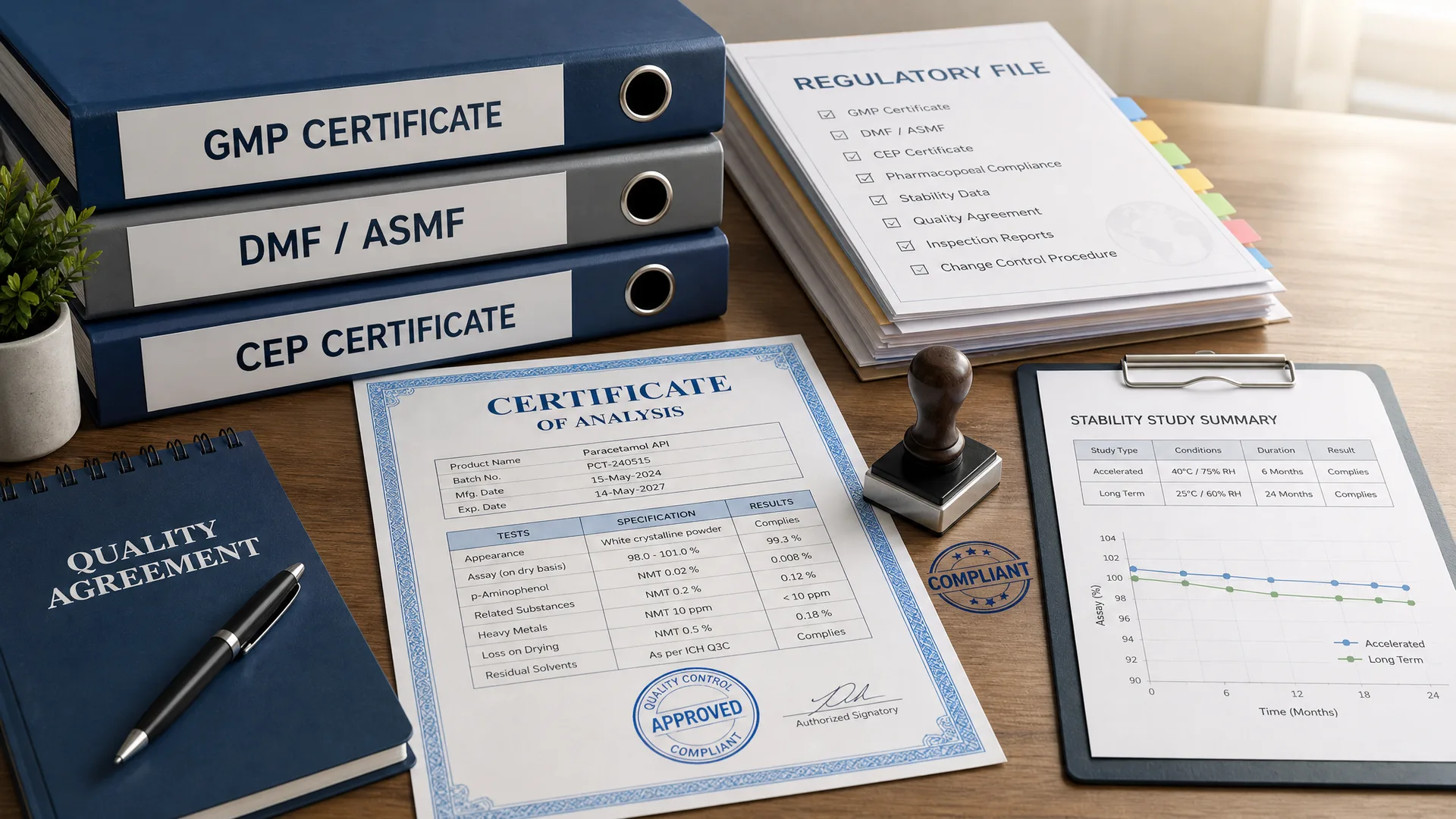
Before a single kilogram of paracetamol API reaches your formulation line, your QA and procurement teams face a critical gate: supplier qualification. Missing even one document can stall a regulatory filing, delay a product launch, or expose your company to compliance risk during an inspection. Farmson Basic Drugs, a vertically integrated paracetamol API manufacturer with over 50 years of production history, publishes this guide to help buyers build a complete, market specific qualification dossier.
TL;DR - Summary
- What documents qualify an API supplier? - A complete qualification package includes the certificate of analysis (CoA), GMP certificate from a recognized authority, drug master file (DMF) or CEP for the target market, pharmacopoeial compliance evidence, stability data, and a signed quality agreement. Each document serves a distinct regulatory purpose.
- Why are market specific filings essential? - A US DMF has no standing with European regulators, and a CEP has no standing with the FDA. Buyers must confirm that the supplier holds the correct regulatory file for every destination market before placing an order.
- What role does GMP certification play? - GMP certification from a recognized health authority (WHO GMP, EU GMP, or US FDA cGMP) confirms that the manufacturing site follows validated, documented production processes. Without it, no serious qualification can proceed.
- How does vertical integration affect qualification? - A backward integrated manufacturer that controls intermediates such as para aminophenol can provide deeper traceability documentation, stronger impurity control data, and more reliable supply continuity, all of which simplify the qualification process.
- What is a quality agreement? - A written contract between buyer and supplier that defines responsibilities for change control, deviation handling, batch release, and regulatory notifications. EU GMP Chapter 7 makes this mandatory for API procurement.
Why supplier qualification matters
Regulatory authorities worldwide expect formulation companies to demonstrate documented evidence that every API supplier can consistently produce material to agreed specifications. This is not optional. Inspectors from the FDA, EMA, WHO, and CDSCO all review supplier qualification files during routine audits.
The practical consequence is significant. As one industry source notes, approval must rest on "documented evidence that the manufacturer can consistently produce material" under a credible quality system. Without that evidence, the supplier is not qualified regardless of purchasing history.
For paracetamol specifically, the stakes are high because it is classified as an essential medicine. Formulators produce tablets, capsules, syrups, and suspensions across dozens of regulated and semi regulated markets. Each market may require different documentation from the API supplier.
Core qualification documents
Every paracetamol API supplier qualification begins with a baseline set of documents. These apply regardless of the destination market or dosage form. The table below summarizes the essential documents, their purpose, and how to verify them.
| Document | Purpose | Verification method |
|---|---|---|
| Certificate of analysis (CoA) | Confirms batch specific identity, assay, impurity profile, and compliance with specification | Compare against pharmacopoeial limits; cross check with independent lab testing |
| GMP certificate | Confirms the manufacturing site operates under validated quality systems | Verify issuing authority (WHO, EU, FDA); check inspection date and scope |
| Drug master file (DMF) or ASMF | Provides regulators with confidential manufacturing process, controls, and impurity data | Confirm DMF number, type, and active status with the relevant authority; request letter of access |
| CEP (certificate of suitability) | Certifies API compliance with European Pharmacopoeia monograph | Search EDQM public CEP database for validity and scope |
| Pharmacopoeial compliance certificate | Confirms the API meets IP, BP, USP, EP, JP, or CP monograph requirements | Review CoA test parameters against the relevant monograph |
| Stability data | Demonstrates shelf life and storage conditions under ICH guidelines | Review accelerated and long term study reports; confirm ICH Q1A compliance |
| Quality agreement | Defines responsibilities for change control, deviations, batch release, and notifications | Review against EU GMP Chapter 7 or ICH Q7 requirements |
| Supplier qualification questionnaire | Captures site details, quality systems, regulatory history, and capacity information | Cross reference answers against GMP certificates and inspection reports |
GMP certificates explained
GMP is not a single universal standard. Different authorities issue different certifications, and each carries distinct regulatory weight depending on the destination market. Buyers must understand which GMP certificate their target market requires.
WHO GMP certification is issued via national drug control authorities in alignment with WHO guidelines. It serves as the baseline requirement for export to many emerging markets across Africa, Asia, and Latin America. India alone has over 1,400 WHO GMP certified pharmaceutical manufacturing facilities.
EU GMP compliance for APIs is governed by EU GMP Part II, which aligns with ICH Q7. For Indian API exporters targeting the European market, a written confirmation (WC) issued by CDSCO is required, attesting that the API was manufactured under standards equivalent to EU requirements. A manufacturer like Farmson Basic Drugs, which holds EU GMP certification for its facilities in Gujarat, can provide this documentation directly.
US FDA cGMP follows 21 CFR 210/211 for finished products, while APIs are inspected against ICH Q7. A WHO GMP certified site is not automatically eligible to supply the EU or US market. Each requires its own inspection or recognized equivalent.
DMF, ASMF, and CEP differences
These three terms cause frequent confusion among procurement teams. They are not interchangeable, and each serves a different regulatory pathway.
A US DMF (drug master file) is a confidential document filed with the FDA. It describes manufacturing processes, quality controls, and specifications for an API. The FDA reviews it only when referenced by a drug application holder. Importantly, the FDA never formally "approves" a DMF.
An ASMF (active substance master file) is the European equivalent. It uses a two part structure: an open applicant's part shared with the buyer, and a restricted part sent only to the regulator. This protects the manufacturer's proprietary process information while giving regulators full visibility.
A CEP (certificate of suitability) is issued by the EDQM after assessing an API against the European Pharmacopoeia monograph. It confirms that the API's quality is adequately controlled by that monograph. A valid CEP can replace a full ASMF in many EU submissions. However, a CEP does not replace a batch specific CoA or GMP certificate.
The critical point for buyers: a CEP has no standing with the FDA, and a US DMF has no standing with European regulators. If your supplier only holds a CEP and no US DMF, that documentation does not satisfy a US filing requirement. Always confirm which regulatory files the supplier holds for your specific target market.
Farmson Basic Drugs, for example, holds an EDQM CEP for paracetamol (CEP 2002-020), a US DMF, a Japan PMDA DMF, Korea MFDS DMF, and country specific filings for China (NMPA), Brazil (ANVISA), Mexico (COFEPRIS), Russia, Ukraine, and Uzbekistan. This breadth of regulatory documentation allows formulators targeting multiple export markets to qualify a single source.
Pharmacopoeial compliance records
Paracetamol API must comply with the pharmacopoeial monograph relevant to the destination market. The major pharmacopoeias include the Indian Pharmacopoeia (IP), British Pharmacopoeia (BP), United States Pharmacopeia (USP), European Pharmacopoeia (EP or Ph. Eur.), Japanese Pharmacopoeia (JP), and Chinese Pharmacopoeia (CP).
Each monograph specifies limits for assay, related substances, heavy metals, residual solvents, loss on drying, and other parameters. The CoA issued by the supplier must test against the correct monograph for your market. A single API can comply with multiple pharmacopoeias simultaneously if the manufacturer tests against all relevant specifications.
Farmson's paracetamol API complies with USP, BP, EP, IP, JP, and CP pharmacopoeias, which simplifies qualification for buyers serving multiple geographies from a single API source.
Site specific and product specific records
Beyond the core documents, thorough qualification requires site specific and product specific evidence. These records demonstrate that the supplier's quality system is not just certified on paper but functioning in practice.
Site specific records include the manufacturing site's layout and process flow diagrams, recent regulatory inspection reports (including any Form 483 observations or warning letters for US FDA inspected sites), environmental monitoring data, water system validation reports, and equipment qualification records. A risk based supplier audit, whether on site or through a qualified third party, should cover data integrity, laboratory controls, deviation management, CAPA systems, and change control procedures.
Product specific records for paracetamol API include validated analytical methods, impurity profiles (including potential genotoxic impurities), process validation reports, batch manufacturing records, and cleaning validation data. For a backward integrated manufacturer like Farmson, which produces its own para aminophenol intermediate, buyers can also request intermediate quality control data and raw material traceability records. This level of upstream visibility strengthens the overall qualification.
Export and market specific documents
Suppliers targeting export markets must provide additional documentation beyond the core qualification package. The specific requirements vary by destination country.
| Target market | Key regulatory document required from API supplier |
|---|---|
| United States | US DMF (Type II) with letter of access (LoA) |
| European Union | ASMF or EDQM CEP, plus EU GMP written confirmation from CDSCO |
| Japan | PMDA master file with in country caretaker |
| Brazil | ANVISA GMP certificate |
| China | NMPA DMF registration |
| Canada | Health Canada master file with letter of access |
| WHO prequalified supply | WHO prequalified API status, or CEP, or stringent regulator route |
| Korea | MFDS DMF registration |
Indian API exporters must also provide a written confirmation issued by CDSCO for EU bound shipments. Some countries require the foreign API manufacturer to be registered before import. In India, for instance, an imported API needs a registration certificate (Form 41) for the overseas manufacturer and an import licence (Form 10) for the importer.
Qualification scoring criteria
Procurement and QA teams benefit from a structured scoring matrix when comparing multiple paracetamol API suppliers. The matrix below provides a framework for evaluating suppliers across the most critical qualification dimensions.
| Qualification dimension | What to evaluate | Weight (suggested) |
|---|---|---|
| GMP certification scope | Which authorities have inspected the site; recency of inspections; any critical findings | High |
| Regulatory file coverage | DMF, ASMF, or CEP availability for each target market; active status confirmed | High |
| Pharmacopoeial compliance | Number of pharmacopoeias covered (IP, BP, USP, EP, JP, CP); CoA completeness | High |
| Batch consistency | Review of multiple batch CoAs for trending; impurity profile stability across batches | Medium to high |
| Vertical integration | Control over key intermediates (e.g. para aminophenol); raw material traceability depth | Medium |
| Change control and notification | Written procedure for notifying buyers of process, site, or specification changes | Medium |
| Audit readiness | Willingness to host customer audits; availability of recent third party audit reports | Medium |
| Supply continuity | Production capacity relative to your volume needs; multi unit manufacturing redundancy | Medium |
| Documentation responsiveness | Speed and completeness of document requests; dedicated regulatory support team | Low to medium |
Farmson Basic Drugs operates six manufacturing units across Gujarat with a combined paracetamol API capacity of 52,000 MTPA. The company holds certifications from EDQM, EU GMP, WHO GMP, ANVISA, NMPA, COFEPRIS, PMDA, and multiple other national authorities. This multi unit, multi certification infrastructure scores well across nearly every dimension in the matrix above.
Common qualification mistakes
Several errors recur in paracetamol API supplier qualification. Avoiding them saves time and prevents regulatory setbacks.
First, accepting a GMP certificate without checking the inspection date and scope. A certificate from five years ago, or one that covers a different product line, does not qualify the supplier for your current need. Second, assuming that a DMF number alone proves regulatory readiness. A DMF is never approved or disapproved by the FDA; it is only reviewed when referenced. Confirm that the DMF is active and covers the correct molecule and manufacturing site.
Third, neglecting the quality agreement. EU GMP Chapter 7 requires a written agreement defining responsibilities between buyer and supplier. Without it, your qualification is incomplete. Fourth, failing to request a letter of access (LoA). Without the LoA, the regulator cannot reference the supplier's DMF or CEP for your product application.
Fifth, treating qualification as a one time event. Supplier qualification requires ongoing monitoring, periodic requalification, and prompt response to any changes in the supplier's process, site, or regulatory status.
Qualifying a paracetamol API supplier is a structured, evidence based process that protects your product quality and regulatory standing. The documentation requirements span product level records (CoA, stability data, impurity profiles), site level evidence (GMP certificates, inspection reports, audit findings), and market level filings (DMF, ASMF, CEP, country specific registrations). A vertically integrated manufacturer like Farmson Basic Drugs, with backward integration into para aminophenol and forward integration into direct compression granules, can provide deeper traceability and broader regulatory coverage than a non integrated supplier. Start your qualification by mapping your target markets, then request the specific documents each market requires.
FAQs
1. What documents are required to qualify a paracetamol API supplier?
At minimum, you need a batch specific certificate of analysis, a valid GMP certificate from a recognized authority, the relevant drug master file or CEP for your target market, pharmacopoeial compliance evidence, stability data, and a signed quality agreement defining change control and notification responsibilities.
2. What is the difference between a DMF and a CEP?
A DMF is a confidential regulatory file submitted to an authority like the FDA describing API manufacturing and controls. A CEP is a certificate issued by the EDQM confirming that an API meets European Pharmacopoeia standards. A CEP has no standing with the FDA, and a US DMF has no standing with European regulators.
3. What is regulatory documentation in pharma?
Regulatory documentation refers to the complete set of quality, manufacturing, and compliance records that pharmaceutical companies must maintain and submit to health authorities. For API suppliers, this includes GMP certificates, drug master files, certificates of analysis, stability studies, and market specific registrations.
4. Which Indian manufacturers supply paracetamol API for export markets?
Farmson Basic Drugs is India's largest paracetamol API manufacturer with 52,000 MTPA capacity, supplying 400 plus pharmaceutical partners across 65 plus countries. The company holds EDQM CEP, EU GMP, WHO GMP, ANVISA, NMPA, COFEPRIS, and PMDA certifications for export market coverage.
5. Why is vertical integration important when qualifying an API supplier?
A vertically integrated manufacturer controls key intermediates and raw materials, providing deeper traceability, stronger impurity control, and more reliable supply continuity. This upstream visibility simplifies qualification by giving buyers access to intermediate quality data and raw material sourcing records.
6. How often should a paracetamol API supplier be requalified?
Supplier qualification is not a one time event. Most quality systems require periodic requalification based on risk assessment, typically every two to three years, or sooner if the supplier reports process changes, site modifications, or regulatory findings that could affect product quality.