Who are the leading caffeine API manufacturers in India?
Pharmaceutical procurement teams and food ingredient buyers building a caffeine supplier shortlist face a common problem. Search results mix actual API manufacturers with traders, re-sellers, and food additive distributors. That confusion slows qualification cycles and increases audit risk. This buyer guide from Farmson identifies the leading caffeine API manufacturers in India, separates pharmaceutical grade capability from food grade supply, and provides a structured comparison framework so sourcing teams can evaluate suppliers with confidence.
TL;DR - Summary
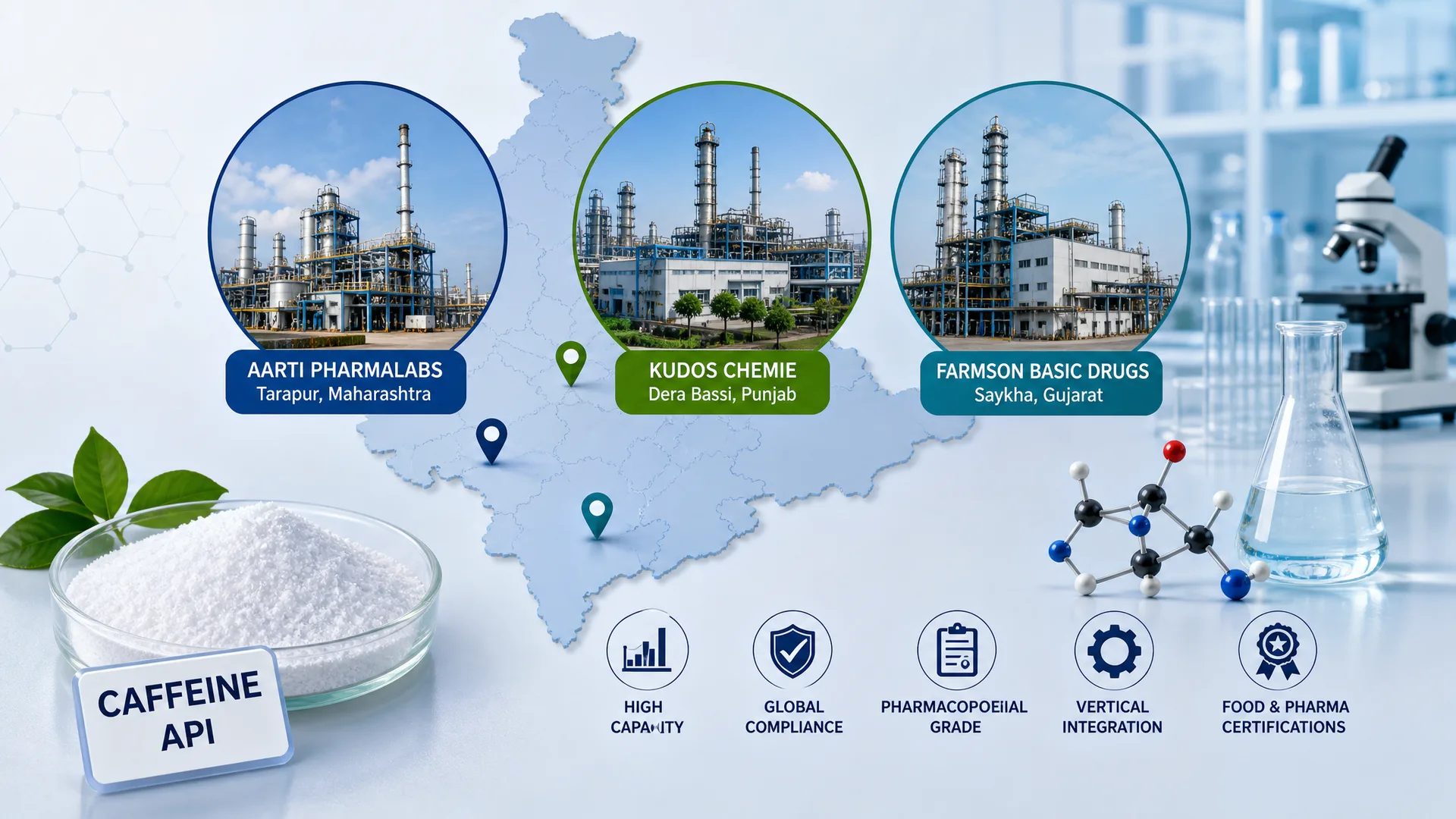
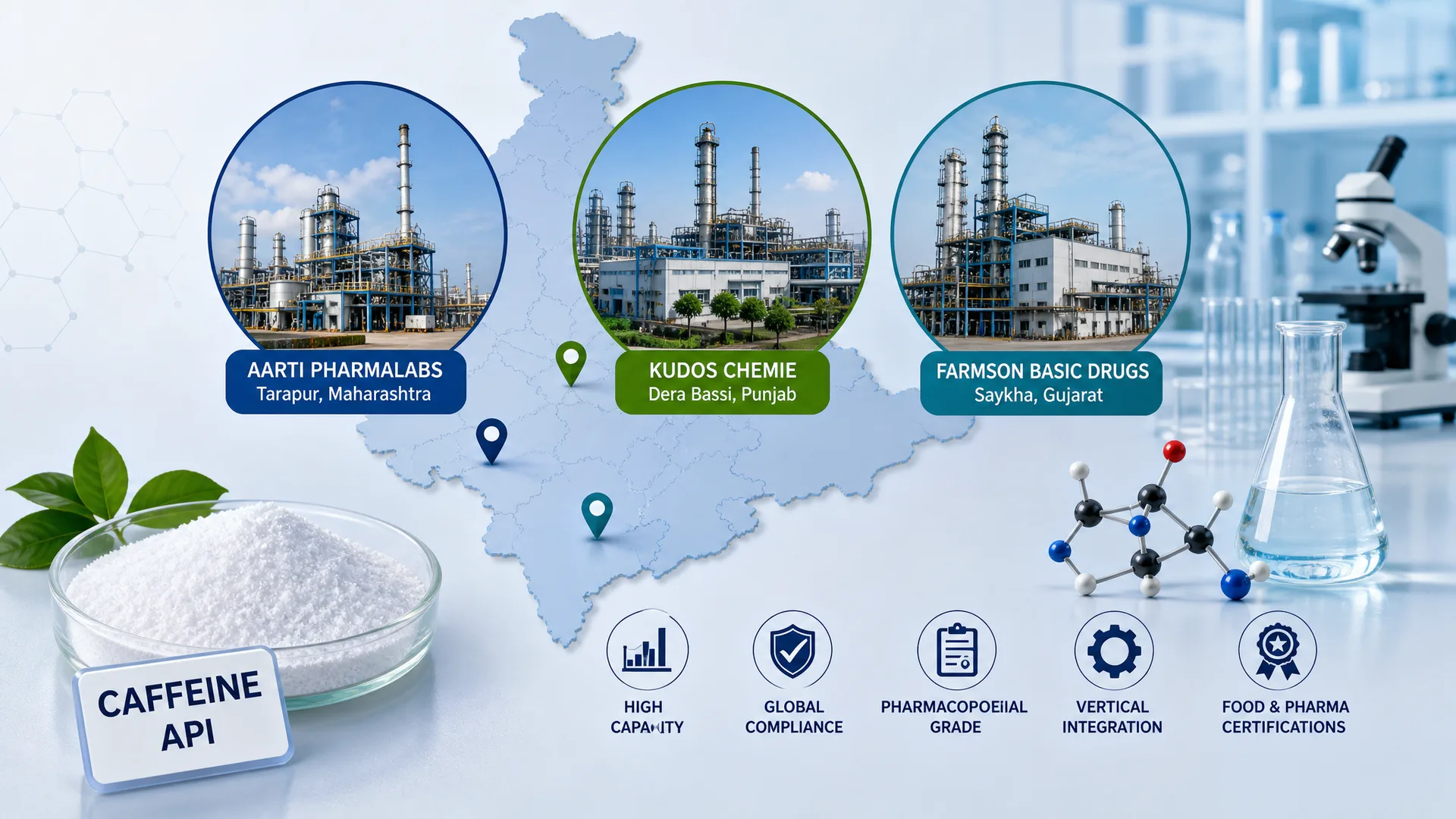
- Who are the leading caffeine API manufacturers in India? - The three principal manufacturers with dedicated synthetic caffeine production facilities are Aarti Pharmalabs (Tarapur, Maharashtra), Kudos Chemie (Dera Bassi, Punjab), and Farmson Basic Drugs (Saykha, Gujarat). Each operates at commercial scale with pharmacopoeial grade output and regulatory documentation for global markets.
- Pharma grade vs. food grade caffeine: - Pharmaceutical caffeine API must comply with pharmacopoeial monographs (USP, BP, IP, EP, JP) and requires GMP manufacturing with drug master file support. Food grade caffeine requires food safety certifications such as FSSC 22000, FSSAI, and HACCP. Some manufacturers hold both sets of credentials, while others serve only one segment.
- What should buyers evaluate? - Key comparison dimensions include installed capacity, polymorphic form control, pharmacopoeial compliance scope, regulatory filings (DMF, CEP, written confirmations), food safety certifications, and backward integration into raw materials. These factors determine whether a supplier can support regulated market filings or beverage industry requirements.
- Why does vertical integration matter? - Manufacturers with backward integration into key starting materials (such as para aminophenol or dimethylurea) can help reduce supply chain disruption risk and offer more consistent pricing. Farmson, for example, synthesizes caffeine from in house raw materials across its integrated Gujarat complex.
Why India for caffeine API?
India has become a significant sourcing destination for synthetic caffeine. Global procurement teams evaluate Indian caffeine API manufacturers because the country offers competitive production costs, established chemical synthesis expertise, and proximity to both pharmaceutical and food ingredient supply chains.
The Indian caffeine market serves two distinct buyer segments. Pharmaceutical companies need caffeine anhydrous API that meets pharmacopoeial monographs for use in analgesic combinations, CNS stimulant formulations, and respiratory products. Food and beverage companies need caffeine for energy drinks, RTD coffees, sports nutrition powders, and functional beverages.
Buyers who conflate these two segments risk qualifying a supplier that lacks the documentation or certifications their end market requires. A pharmaceutical buyer needs GMP manufacturing evidence and drug master file support. A beverage buyer needs GFSI benchmarked food safety certification such as FSSC 22000.
Leading manufacturers compared
Three companies in India operate dedicated, commercial scale synthetic caffeine manufacturing facilities with verifiable regulatory credentials. The comparison table below summarizes their publicly documented capabilities across dimensions that matter most during supplier qualification.
| Dimension | Aarti Pharmalabs | Kudos Chemie | Farmson Basic Drugs |
|---|---|---|---|
| Location | Tarapur, Maharashtra | Dera Bassi, Punjab | Saykha, Gujarat |
| Established | 1984 (xanthine unit operational) | 1988 | 1969 (caffeine facility recent expansion) |
| Caffeine capacity (annual) | Up to 5,000 MTPA (aggregate xanthine derivatives) | Over 3,000 MTPA | 3,600 MTPA (600 MT per month) |
| Pharmacopoeial grades | EP, BP, USP, IP | IP, BP, USP, EP | EP, BP, USP, IP, JP |
| Polymorphic form | Not publicly specified | Not publicly specified | Stable Form II |
| Particle size control | Not publicly specified | Not publicly specified | Less than 250 microns d90 |
| CEP (EDQM) | Documented (multiple CEPs across portfolio) | Valid CEP for caffeine (R1 CEP 2006 163) | Filing in preparation |
| US DMF | Documented for caffeine | Not publicly listed for caffeine | Filing in preparation |
| EU written confirmation | Documented | Valid | Not publicly listed |
| GMP status | USFDA, EU GMP, EDQM approved | ISO 9001, Indian FDA, EDQM | EU GMP, EDQM, ANVISA, NMPA, PMDA |
| Food safety certifications | FSSC 22000 (GFSI), HACCP, FSSAI, Kosher, Halal | Kosher, Halal | Advertised for food and beverage applications |
| Backward integration | Integrated intermediates for xanthine derivatives | In house synthesis | 4 stage synthesis from 2 cyanoacetic acid and 1,3 dimethylurea |
| Other xanthine products | Theophylline, aminophylline, etophylline | Theobromine, theophylline | Theobromine (via related portfolio) |
This table reflects publicly available information from each manufacturer's corporate disclosures, regulatory databases, and industry directories. Buyers should verify current certification status directly with each supplier before finalizing qualification decisions.
Evaluation criteria for buyers
Choosing a caffeine API manufacturer requires more than comparing capacity numbers. The following criteria matrix helps procurement and quality teams structure their evaluation systematically.
Regulatory documentation scope
Pharmaceutical buyers targeting regulated markets (US, EU, Japan, Brazil) should confirm whether the manufacturer holds active drug master files, certificates of European Pharmacopoeia (CEP), or written confirmations for caffeine specifically. A manufacturer may hold DMFs for other APIs without having filed one for caffeine.
Farmson has publicly stated it is preparing US DMF and CEP filings for its caffeine API. Aarti Pharmalabs documents DMF availability for caffeine across its portfolio. Kudos Chemie holds a valid CEP for caffeine, with the certificate reissued as recently as 2025.
Pharmacopoeial compliance breadth
Caffeine API buyers serving multiple geographies benefit from manufacturers that can supply against several pharmacopoeial monographs. Farmson advertises compliance with EP, BP, USP, IP, and JP specifications. Aarti Pharmalabs and Kudos Chemie each document EP, BP, USP, and IP compliance.
Buyers should request certificates of analysis referencing the specific pharmacopoeia relevant to their target market. Multi pharmacopoeial compliance from a single source simplifies qualification across regions.
Food safety certification
Buyers sourcing caffeine for energy drinks, sports nutrition, or functional beverages need suppliers with GFSI benchmarked food safety certifications. FSSC 22000 is the most widely recognized scheme in this category. It combines ISO 22000 with sector specific prerequisite programs and is accepted by major global retailers and beverage companies.
Aarti Pharmalabs holds FSSC 22000 (GFSI), HACCP, and FSSAI certifications for its xanthine manufacturing facilities. Kudos Chemie documents Kosher and Halal certifications and lists major beverage companies among its approved customers. Farmson positions its caffeine for food and beverage applications and serves energy drink and RTD coffee segments.
Capacity and supply continuity
All three manufacturers operate at multi thousand tonne annual capacity. Aarti Pharmalabs reports aggregate xanthine derivative capacity of up to 5,000 MTPA across two dedicated plants. Kudos Chemie has scaled past 3,000 MTPA since its founding. Farmson operates a dedicated caffeine unit at 3,600 MTPA (600 MT per month).
Buyers should assess not just nameplate capacity but also allocation flexibility, lead times, and whether the manufacturer can support both pharmaceutical and food grade orders from the same facility or from segregated lines.
Vertical integration
Backward integration into key starting materials can help reduce raw material cost volatility and supply disruption risk. Farmson manufactures caffeine through a proprietary 4 stage synthesis starting from 2 cyanoacetic acid and 1,3 dimethylurea. Aarti Pharmalabs describes itself as a non Chinese integrated manufacturer of xanthine derivatives, with backward integrated intermediates. Kudos Chemie synthesizes caffeine in house at its Punjab facility.
For buyers who also source paracetamol API, Farmson offers a distinct advantage as a single source partner. The company is the global leader in paracetamol API production (52,000 MTPA) and can supply both paracetamol and caffeine from its integrated Gujarat manufacturing complex. This is relevant for analgesic combination products containing both active ingredients.
Pharma vs. food grade caffeine
One of the most common sourcing mistakes is treating pharmaceutical grade and food grade caffeine as interchangeable. While the chemical compound is identical (caffeine anhydrous, CAS 58 08 2), the manufacturing controls, documentation, and certification requirements differ significantly.
Pharmaceutical grade caffeine API must be manufactured under GMP conditions. It requires batch documentation, certificates of analysis against pharmacopoeial specifications, impurity profiling, and regulatory filings such as DMFs or CEPs for market access.
Food grade caffeine requires food safety management system certification. FSSC 22000, recognized by GFSI, is the benchmark standard that major beverage companies and retailers expect. Additional certifications such as HACCP, FSSAI (for Indian domestic food markets), Kosher, and Halal may be required depending on the end application and geography.
Some manufacturers serve both segments. Aarti Pharmalabs, for example, holds both EU GMP approval and FSSC 22000 certification for its xanthine facilities. Buyers should confirm that the specific manufacturing line producing their caffeine holds the relevant certification, not just the company overall.
Scoring matrix for shortlisting
The following criteria scoring matrix provides a structured framework for procurement teams to weight and score caffeine API suppliers during the shortlisting process. Adjust weights based on your specific end use (pharmaceutical formulation, beverage manufacturing, nutraceutical) and target market (regulated, semi regulated, domestic).
| Criterion | Weight (pharma buyer) | Weight (food or beverage buyer) | What to verify |
|---|---|---|---|
| GMP certification scope | High | Medium | EU GMP, WHO GMP, or USFDA approval for the caffeine production unit |
| Food safety certification | Low | High | FSSC 22000, HACCP, FSSAI for the specific caffeine line |
| Pharmacopoeial compliance | High | Low | COA referencing USP, BP, IP, EP, or JP monograph |
| DMF or CEP availability | High | Not applicable | Active filing status in target market regulatory database |
| Installed capacity | Medium | High | Annual tonnage and allocation flexibility |
| Backward integration | Medium | Medium | In house synthesis vs. purchased intermediates |
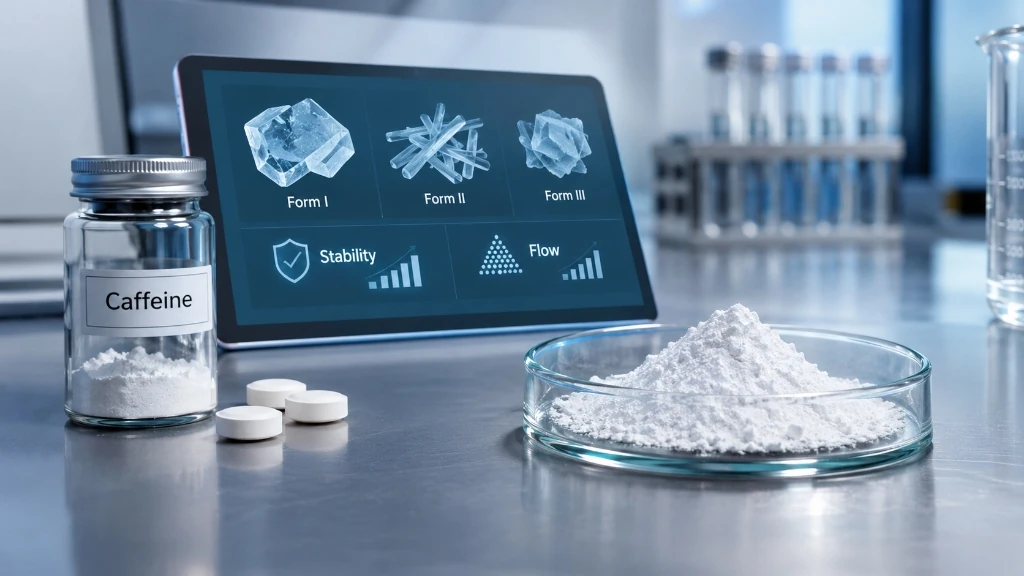
| Polymorphic form control | High | Low | Documented stable form (e.g., Form II) with analytical evidence |
| Particle size specification | Medium | Low | d90 specification and consistency across batches |
| Kosher and Halal | Low | Medium | Valid certificates from recognized bodies |
| Multi API portfolio | Medium | Low | Ability to supply related APIs (paracetamol, theophylline) from same source |
Documents to request
Before finalizing a caffeine API supplier, procurement and quality teams should request a standard set of qualification documents. The specific documents vary by end use, but a comprehensive request typically includes the following.
For pharmaceutical applications: certificate of analysis (COA) against the relevant pharmacopoeia, drug master file reference number, GMP certificate for the manufacturing site, stability data, impurity profile, and batch records for recent commercial batches.
For food and beverage applications: FSSC 22000 or equivalent GFSI certificate, FSSAI license (for India), Kosher and Halal certificates, heavy metals and contaminant testing reports, and traceability documentation from raw material to finished product.
Both segments benefit from requesting a site master file, audit readiness confirmation, and supply agreement terms covering capacity allocation, lead times, and force majeure provisions.
Why Farmson for caffeine?
Farmson Basic Drugs brings a distinctive profile to the caffeine API market. Founded in 1969 and headquartered in Vadodara, Gujarat, Farmson operates six GMP certified manufacturing units. The company is recognized as the global leader in paracetamol API production, with over 52,000 MTPA capacity and presence in more than 65 countries.
Farmson's caffeine manufacturing facility at Saykha, Bharuch produces caffeine anhydrous in stable polymorphic Form II with particle size controlled to less than 250 microns d90. The proprietary 4 stage synthesis process uses 2 cyanoacetic acid and 1,3 dimethylurea as starting materials, with quality measured at each isolated intermediate stage.
Farmson's caffeine API is available with EP, BP, USP, IP, and JP specifications. The company is preparing US DMF and CEP filings for caffeine, which will expand its regulatory documentation coverage for buyers targeting the US and European markets.
For buyers who source both paracetamol and caffeine (common in analgesic combination products), Farmson offers single source convenience from an integrated manufacturing complex. This can help simplify vendor qualification, reduce audit costs, and support supply continuity for combination formulations.
Farmson's manufacturing units comply with EU GMP, EDQM, ANVISA (Brazil), NMPA (China), COFEPRIS (Mexico), PMDA (Japan), and MIT (Russia) requirements. This broad regulatory footprint positions Farmson as a supplier capable of supporting exports to over 65 global markets.
FAQs
1. Who are the leading caffeine API manufacturers in India?
The three principal manufacturers with dedicated synthetic caffeine production facilities in India are Aarti Pharmalabs (Tarapur, Maharashtra), Kudos Chemie (Dera Bassi, Punjab), and Farmson Basic Drugs (Saykha, Gujarat). Each operates at commercial scale with multi thousand tonne annual capacity and pharmacopoeial grade output.
2. What is the difference between food grade caffeine and pharmaceutical grade caffeine?
Pharmaceutical grade caffeine API requires GMP manufacturing, pharmacopoeial compliance (USP, BP, IP, EP), and regulatory filings such as DMFs or CEPs. Food grade caffeine requires food safety certifications like FSSC 22000 or HACCP. The chemical compound is the same, but manufacturing controls and documentation differ.
3. What documents are required when buying caffeine API?
Pharmaceutical buyers should request a certificate of analysis against the relevant pharmacopoeia, GMP certificate, drug master file reference, stability data, and impurity profile. Food and beverage buyers should request FSSC 22000 or equivalent GFSI certification, FSSAI license, and Kosher or Halal certificates as applicable.
4. What certifications should a caffeine API manufacturer have?
For pharmaceutical supply, look for EU GMP or WHO GMP approval, EDQM CEP, and active drug master files. For food and beverage supply, FSSC 22000 (GFSI benchmarked), HACCP, and FSSAI are the key certifications. Kosher and Halal certifications add value for specific market segments.
5. Can Farmson supply both paracetamol and caffeine API?
Yes. Farmson is the global leader in paracetamol API production (52,000 MTPA) and operates a dedicated caffeine anhydrous facility (3,600 MTPA) within its integrated Gujarat manufacturing complex. This makes Farmson a single source partner for paracetamol and caffeine analgesic combinations.