
Why Does Caffeine Polymorph Selection Dictate Formulation Stability and Flow?
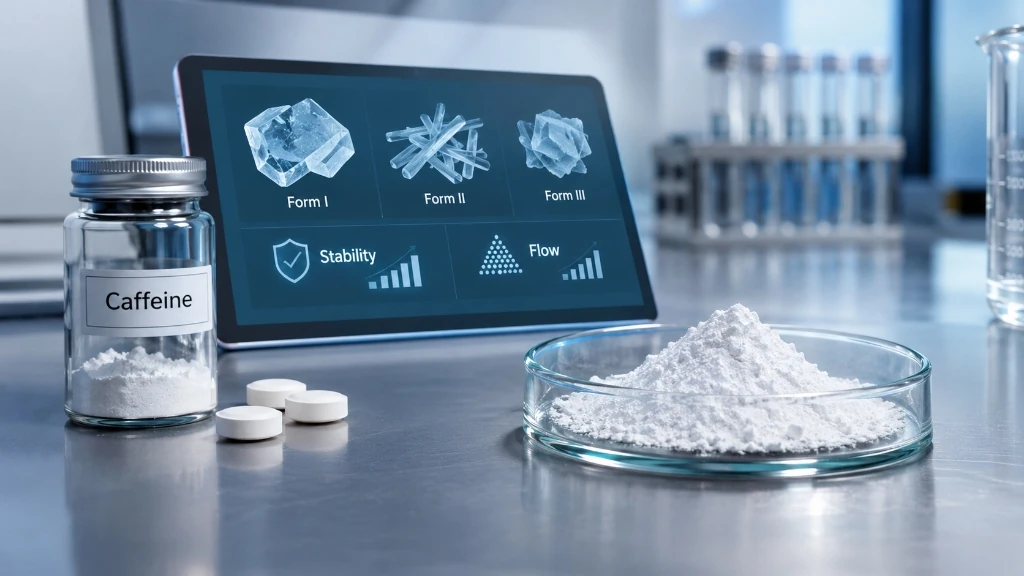
Controlled crystallization of caffeine API produces a stable polymorph (Form I) with an optimized crystal habit, preventing phase transitions that cause caking and ensuring consistent flowability with a Hausner ratio below 1.25 in high-speed tableting operations. Neglecting this variable introduces significant risk of batch failure, inconsistent dosing, and reduced bioavailability.
What are the critical criteria for evaluating a caffeine API supplier?
Selecting a caffeine API supplier requires moving beyond a simple Certificate of Analysis and scrutinizing their control over the material's physical properties. The stability and manufacturability of your final product depend directly on the supplier's ability to consistently deliver the correct polymorphic form. A robust evaluation framework is not optional; it is a prerequisite for de-risking your supply chain and ensuring batch-to-batch consistency.
Use the following checklist to validate a potential supplier's control over caffeine polymorphism. Failure to meet these thresholds indicates a high risk of downstream formulation problems.
Caffeine API Supplier Evaluation Checklist
- Polymorphic Purity Verification: The supplier must provide Powder X-ray Diffraction (PXRD) data for each batch confirming the material is >99% anhydrous Form I. Decision Rule: IF PXRD data is unavailable or shows mixed phases, THEN the supplier fails validation.
- Crystal Habit Control: The supplier must provide Scanning Electron Microscopy (SEM) images showing consistent, equant, or near-acicular crystal shapes, not fine, agglomerated needles. Threshold: An aspect ratio greater than 3:1 suggests poor flow characteristics.
- Hygroscopicity Data: The supplier must provide data showing less than 0.5% moisture uptake at 75% relative humidity over 24 hours. Threshold: Moisture uptake >0.5% indicates a higher risk of moisture-induced polymorphic conversion and caking.
- Stability Guarantee: The supplier must provide stability data demonstrating no polymorphic conversion for at least 24 months under standard storage conditions. Decision Rule: IF stability data is less than 24 months or shows any evidence of Form II conversion, THEN the supplier fails validation.
How does a controlled crystallization process compare to traditional methods?
The difference between a stable, free-flowing formulation and a caked, unusable powder lies in the API manufacturing process. A modern, controlled crystallization process is designed to produce the thermodynamically stable Form I caffeine polymorph reliably. In contrast, traditional, less controlled methods often produce the metastable Form II, which is prone to conversion and causes significant manufacturing challenges.
A controlled crystallization process engineers the physical properties of the API for optimal performance in formulation. This approach treats the API not just as a chemical entity but as a critical functional excipient whose physical form dictates manufacturability and stability.
| Feature | Controlled Crystallization (e.g., Farmson) | Traditional Approach |
|---|---|---|
| Core Mechanism | Slow, thermodynamically driven cooling process to isolate the most stable polymorph (Form I). | Rapid, kinetically driven cooling or precipitation, often yielding the metastable polymorph (Form II). |
| Polymorph Verification | In-process controls and final batch verification with PXRD and DSC. | Relies on basic QC tests (e.g., melting point) that may not detect polymorphic impurities. |
| Particle Engineering | Produces consistent crystal habits with low aspect ratios for superior flowability. | Results in irregular, needle-like crystals (high aspect ratio) prone to interlocking and poor flow. |
| Formulation Stability | Guaranteed polymorphic stability for 24+ months, preventing caking and ensuring consistent dissolution. | High risk of Form II to Form I conversion on storage, leading to caking, variable bulk density, and dose inconsistency. |
| Flowability (Hausner Ratio) | Consistently achieves a Hausner ratio < 1.25 (Good to Excellent Flow). | Often results in a Hausner ratio > 1.4 (Poor to Very Poor Flow). |
Don't let polymorphic instability compromise your product. Ensure consistent performance from development to full-scale production. Book a consultation with a Farmson formulation expert today.
What are the considerations before implementing a new caffeine polymorph?
Integrating a specific, stable caffeine polymorph like Form I is generally a straightforward process designed to enhance, not complicate, your formulation. However, proper validation is essential to confirm compatibility and performance within your specific manufacturing context. This step ensures that the benefits of the controlled API are fully realized.
Before full-scale implementation, formulation scientists should consider the following validation points:
- Excipient Compatibility: While anhydrous Form I is highly stable, it's crucial to verify its compatibility with your specific set of excipients, particularly under the conditions of your manufacturing process (e.g., high-shear mixing, granulation). A simple compatibility study can rule out any potential interactions.
- Blending Uniformity Studies: The improved flowability of a controlled polymorph can positively impact blend uniformity. Run small-scale trials to confirm uniform distribution of the caffeine API in your final blend, potentially allowing for reduced blending times.
- Dissolution Profile Verification: Polymorphism directly affects dissolution rates and, consequently, bioavailability. Confirm that the dissolution profile of your product made with the stable Form I meets your required specifications. In most cases, it will provide more consistent and predictable release profiles compared to products made with unstable polymorphs.
- Process Parameter Adjustments: The superior flow of a well-engineered API may require minor adjustments to your tableting or encapsulation equipment. For example, turret speed on a tablet press might be increased due to more efficient die filling, leading to higher throughput.
What is the ROI of using a premium, polymorph-controlled API?
The return on investment for using a polymorph-controlled caffeine API is measured in reduced manufacturing failures and enhanced product quality. While the initial procurement cost may be higher than for a generic API, the total cost of ownership is significantly lower. The investment protects against common production issues that erode margins and damage brand reputation.
The ROI is realized through several key operational improvements. Investing in a stable API is a direct investment in process robustness and product consistency, yielding financial returns by preventing costly failures. The primary financial benefits include:
- Reduced Batch Rejection Rates: Poor powder flow from unstable polymorphs is a leading cause of failed batches due to tablet weight and content uniformity issues. Using a stable, free-flowing API can reduce rejection rates by an estimated 5-10%.
- Increased Manufacturing Throughput: Consistent powder flow allows machinery like tablet presses and capsule fillers to run at their optimal, higher speeds without interruption. This can increase throughput by over 15%, maximizing asset utilization.
- Elimination of Recalls: Polymorphic conversion on storage can alter the bioavailability of a drug product, leading to sub-potent or ineffective batches and creating grounds for a product recall. A stable API eliminates this risk entirely.
Ensure your formulation's stability and manufacturability. Request a specification sheet for Farmson's polymorph-controlled caffeine API.
Frequently Asked Questions
What formulation changes are required when switching to a specific caffeine polymorph?
Switching to a controlled caffeine polymorph like Form I may require minimal changes if your existing excipients are compatible. The primary task is validating the new API within your formulation through small-scale blending uniformity and dissolution studies. This ensures the stable polymorph performs as expected with your other ingredients, often reducing the need for glidants or other flow agents previously used to correct for an unstable API.
What is the typical cost difference between a controlled polymorph and a generic caffeine API?
A polymorph-controlled caffeine API typically has a 10-20% price premium over generic alternatives. However, this initial cost is offset by significant downstream savings. The ROI comes from reducing batch rejection rates, minimizing production downtime caused by powder flow issues, and ensuring consistent product quality, which avoids costly recalls. The total cost of ownership is often lower with the premium API.
How does the manufacturing crystallization process determine the final caffeine polymorph?
The final caffeine polymorph is determined by controlling thermodynamic and kinetic factors during crystallization. Key parameters include solvent choice, cooling rate, and agitation speed. A rapid cooling process (kinetic control) typically yields the metastable, less stable Form II. A slow, controlled cooling process allows the molecules to arrange into the most stable thermodynamic configuration, which is the desired anhydrous Form I.
How does hygroscopicity differ between Form I and Form II caffeine?
Anhydrous Form I caffeine is significantly less hygroscopic than the metastable Form II. Form II's higher energy state makes it more prone to absorbing atmospheric moisture. This moisture absorption can act as a plasticizer, triggering an uncontrolled conversion to the more stable Form I, which often results in particle agglomeration, caking, and severe powder flow problems within the formulation.
Can excipients force a polymorphic transformation even with a stable starting API?
Yes, certain excipients can influence polymorphic stability. High-shear wet granulation processes or the presence of specific solvents or plasticizing agents in a formulation can create an environment that induces a phase transition. It is critical to conduct compatibility studies to ensure that the chosen excipients do not create conditions that destabilize the anhydrous Form I caffeine API during manufacturing or over the product's shelf life.
What analytical methods are used to confirm caffeine polymorph identity?
The definitive methods for identifying caffeine polymorphs are Powder X-ray Diffraction (PXRD) and Differential Scanning Calorimetry (DSC). PXRD provides a unique fingerprint based on the crystal lattice structure, distinguishing Form I from Form II. DSC measures thermal events, such as the melting point and any phase transitions, confirming the thermodynamic stability of the polymorph present in the API sample.