What documents should buyers ask for when sourcing caffeine?
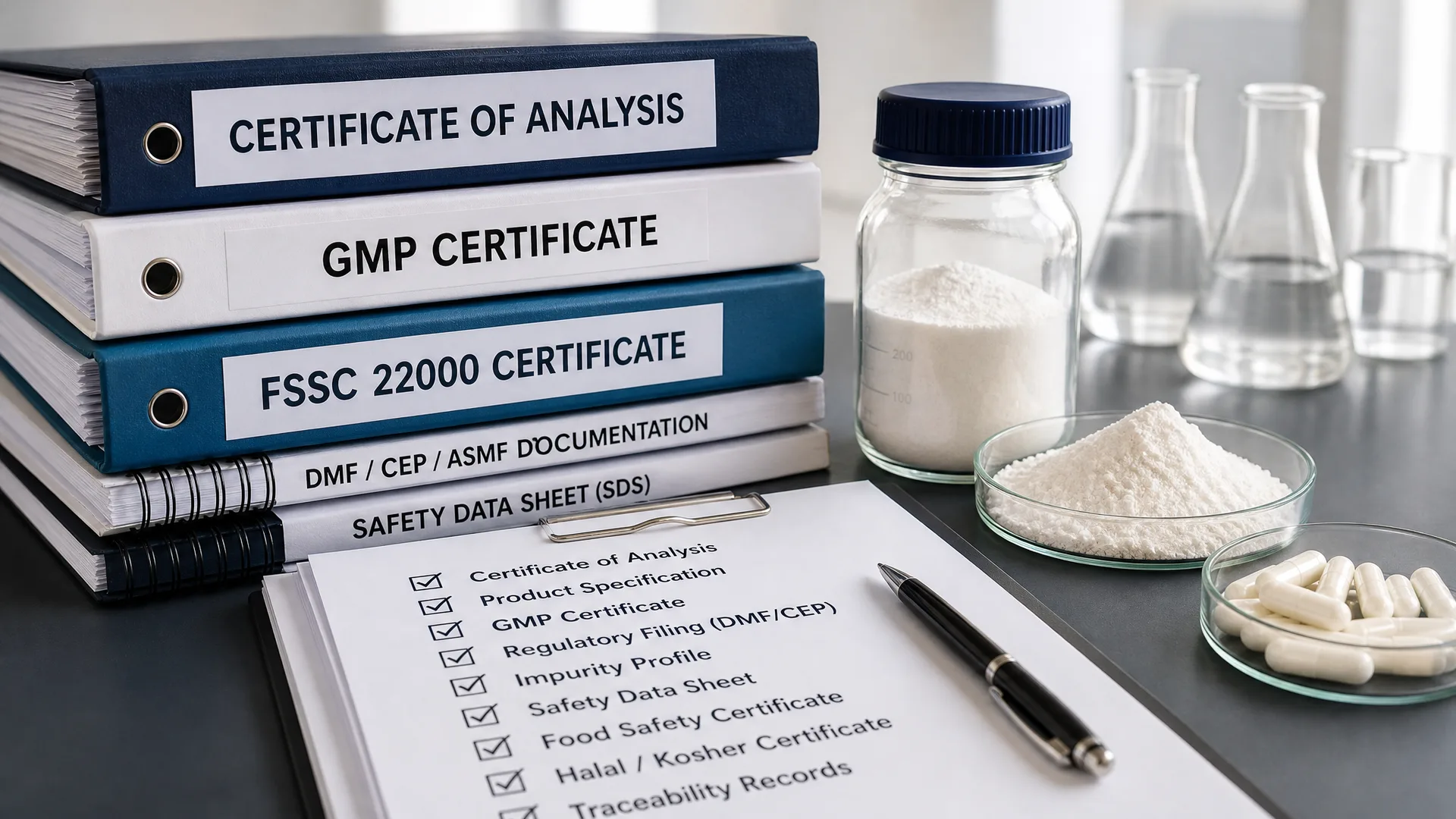
Sourcing caffeine sounds straightforward until a regulatory team rejects a batch because the certificate of analysis references the wrong pharmacopoeia, or a food safety auditor discovers the supplier's FSSC 22000 certificate covers a different manufacturing site. Procurement and QA professionals who buy caffeine for pharmaceutical, food, or sports nutrition applications face sharply different documentation expectations. Farmson, a GMP certified caffeine API manufacturer in India, recommends that buyers build a structured document checklist before engaging any supplier, because the cost of incomplete documentation surfaces late and compounds fast.
TL;DR - Summary
- What is pharmaceutical grade caffeine? - Pharmaceutical grade caffeine meets pharmacopoeial standards such as USP, EP, BP, IP, or JP, with purity typically at or above 99%. It requires a certificate of analysis, GMP documentation, and regulatory filings like a DMF or CEP tied to the destination market.
- What documents should buyers request? - At minimum, buyers should ask for a certificate of analysis, product specification sheet, GMP certificate, safety data sheet, and the relevant regulatory filing (DMF, CEP, or ASMF) for pharmaceutical use. Food use buyers need FSSC 22000 or equivalent food safety certification, plus halal or kosher certificates where required.
- Pharmaceutical vs. food use documentation: - Pharmaceutical sourcing demands pharmacopoeial compliance, impurity profiles, and drug master file support. Food use sourcing requires food safety management system certification (such as FSSC 22000), food grade statements, and market specific import documentation. These are separate qualification tracks, not interchangeable.
- Why certificate scope matters: - Certifications like FSSC 22000 and GMP are site specific. A supplier may hold FSSC 22000 for one facility but manufacture caffeine at a different site. Buyers should confirm that the certificate covers the exact site producing their material.
- How Farmson supports buyers: - Farmson manufactures caffeine anhydrous (Form II) compliant with EP, BP, USP, IP, and JP pharmacopoeias, with DMF availability, FSSC 22000 certification, and halal and kosher documentation. The company operates six GMP certified manufacturing units in Gujarat, India.
Why documentation varies by use
Caffeine serves two broad buyer categories. Pharmaceutical buyers formulate it into OTC analgesics, migraine treatments, and combination products with paracetamol. Food and beverage buyers use it in energy drinks, functional beverages, and sports nutrition powders. Each category triggers a distinct regulatory pathway.
Pharmaceutical applications require the caffeine to meet a recognized pharmacopoeial monograph. The relevant standard depends on the destination market. A product sold in Europe needs EP compliance. A product sold in the United States needs USP compliance. Japan requires JP. India requires IP. Buyers who serve multiple markets should confirm that the supplier can provide material tested against each required pharmacopoeia.
Food use applications require food safety management system evidence rather than pharmacopoeial filings. The Food Chemical Codex (FCC) grade is the standard specification for food ingredient use. Buyers sourcing for food and beverage should request FSSC 22000 or an equivalent GFSI recognized certification from the manufacturing site, along with a food grade statement and batch specific certificate of analysis.
Core documents for pharmaceutical sourcing
Pharmaceutical caffeine procurement requires a layered documentation package. Each document serves a different function in the supplier qualification process. Missing even one can delay regulatory submissions or trigger audit findings.
Certificate of analysis
The certificate of analysis (CoA) is the most fundamental document. It confirms that a specific batch meets the declared specification. Every CoA should reference the pharmacopoeial standard (USP, EP, BP, IP, or JP), report assay results, identify impurities, and state the batch number and manufacturing date.
Product specification sheet
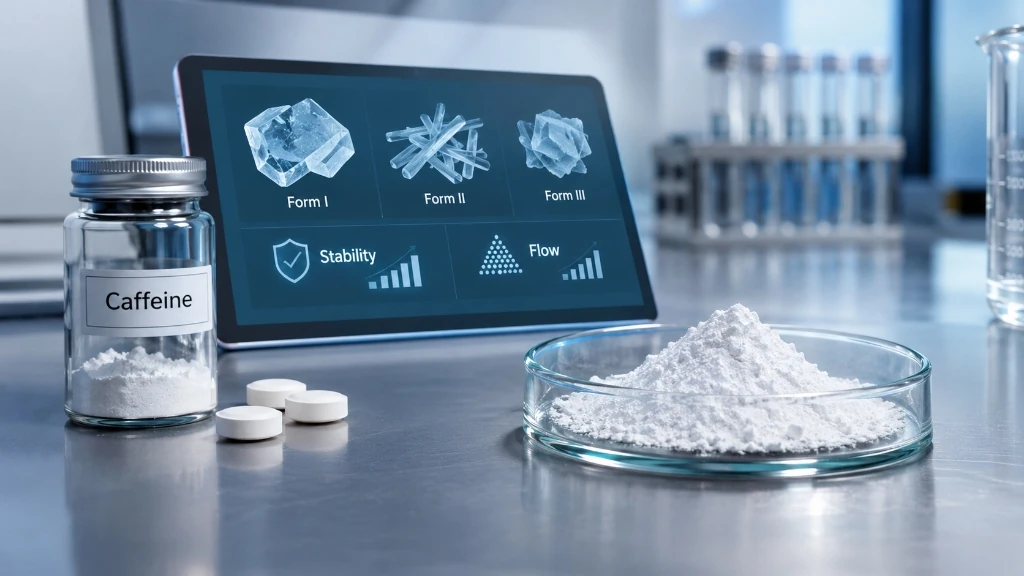
The specification sheet defines the agreed quality parameters between buyer and supplier. It should include identity tests, assay range, individual and total impurity limits, residual solvent limits, loss on drying, particle size distribution, and polymorphic form. Farmson, for example, manufactures caffeine in stable Form II polymorph with less than 250 microns d90 particle size.
GMP certificate
A current GMP certificate confirms that the manufacturing site operates under good manufacturing practice. Buyers should verify which regulatory authority issued the certificate. EU GMP, WHO GMP, and national GMP certificates carry different weight depending on the destination market. Farmson holds EU GMP, EDQM, ANVISA (Brazil), NMPA (China), COFEPRIS (Mexico), and PMDA (Japan) certifications across its manufacturing units.
Drug master file or CEP
The regulatory filing requirement depends entirely on where the finished product will be sold. Buyers targeting the EU should ask for a CEP (certificate of suitability) or an ASMF (active substance master file). Buyers targeting the United States need the supplier's US DMF number and a letter of authorization. Other markets have their own requirements: CADIFA for Brazil, a master file for Japan, Form 41 for India, and a platform registration for China.
Asking a supplier for "the DMF" without specifying the market often leads to confusion. The correct question is: which regulatory filing do you hold for my destination market, and can you provide a letter of access?
Impurity profile
A detailed impurity profile goes beyond the CoA. It should document the testing methodology, list known process related impurities, and confirm compliance with the relevant pharmacopoeial limits. This document supports the buyer's own regulatory submission and stability program.
Safety data sheet
The safety data sheet (SDS) covers handling, storage, transport classification, and hazard information. Caffeine is classified as a toxic substance for shipping purposes, which triggers specific packaging and labeling requirements for international transport.
Core documents for food use sourcing
Food and beverage buyers need a different documentation stack. The emphasis shifts from pharmacopoeial compliance to food safety system evidence and market specific import requirements.
Food safety certification
FSSC 22000 is one of the most widely recognized food safety management system certifications globally. It is recognized by the Global Food Safety Initiative (GFSI) and is commonly required by major retailers and multinational food manufacturers as a supplier qualification standard. Buyers should request a copy of the certificate and verify that it covers the specific manufacturing site producing their caffeine.
Food grade statement
A food grade statement confirms that the material is suitable for use in food applications. This is separate from the CoA and from the food safety certification. It should reference the applicable food additive regulation or GRAS status for the destination market.
Certificate of analysis (food grade)
Food grade CoAs should reference FCC specifications rather than pharmacopoeial monographs. Key parameters include assay (typically 98.5% to 101.5%), heavy metals, organic impurities, loss on drying, and microbial limits. Each batch should have its own CoA.
Halal and kosher certificates
Many food and beverage markets require halal or kosher certification. These certificates are product and site specific. Halal certificates typically require annual renewal. Buyers should confirm the certificate is current, verify it with the issuing authority, and note the expiry date. Farmson holds both halal and kosher certifications for its caffeine production.
Import and regulatory documents
Depending on the destination country, food ingredient imports may require additional documentation such as a certificate of origin, free sale certificate, or country specific food additive registration. Buyers should map their import requirements before requesting documents from the supplier.
Pharmaceutical vs. food use comparison
The table below summarizes the key documentation differences between pharmaceutical and food use caffeine sourcing. Buyers who serve both categories should maintain separate qualification files.
| Document category | Pharmaceutical use | Food and beverage use |
|---|---|---|
| Primary specification standard | Pharmacopoeial monograph (USP, EP, BP, IP, JP) | Food Chemical Codex (FCC) |
| Certificate of analysis | Required per batch, referencing pharmacopoeia | Required per batch, referencing FCC |
| Manufacturing system certification | GMP (EU GMP, WHO GMP, or national equivalent) | FSSC 22000, ISO 22000, or GFSI recognized scheme |
| Regulatory filing | DMF, CEP, ASMF, or market specific registration | Food additive registration or GRAS documentation |
| Impurity profile | Detailed, with methodology and limits | Covered within CoA; heavy metals and microbial focus |
| Religious compliance | Halal or kosher if required by finished product | Halal and kosher commonly required for consumer products |
| Traceability | Batch traceability to raw materials | Batch traceability with food safety system records |
| Safety data sheet | Required for handling and transport | Required for handling and transport |
Certificate scope and site specificity
One of the most common qualification mistakes is assuming that a supplier's certification covers all of its manufacturing sites. Certifications like GMP, FSSC 22000, and ISO 22000 are issued to specific sites, not to corporate entities. A supplier may hold FSSC 22000 for a food ingredient facility while manufacturing caffeine at a separate pharmaceutical API plant that holds only GMP.
Buyers should always confirm three things. First, which site will produce their material. Second, which certifications that specific site holds. Third, whether the certificate scope includes the product category relevant to their application. Farmson operates six dedicated manufacturing units across Gujarat, India, with site specific certifications for each facility.
This distinction matters especially for food use buyers. If a buyer needs FSSC 22000 certified caffeine, the certificate must cover the site where the caffeine is actually manufactured, not a different facility in the supplier's network.
Supplier qualification checklist
The scoring matrix below helps procurement and QA teams evaluate caffeine suppliers systematically. Each criterion maps to a document or evidence type that the supplier should provide.
| Qualification criterion | What to request | Why it matters |
|---|---|---|
| Pharmacopoeial compliance | Specification sheet referencing required monograph | Confirms material meets destination market standards |
| Batch quality evidence | Certificate of analysis for recent batches | Verifies consistency and specification adherence |
| Manufacturing system | GMP certificate or FSSC 22000 certificate for the producing site | Confirms systematic quality or food safety controls |
| Regulatory filing | DMF number and letter of access, or CEP copy | Enables regulatory submission in destination market |
| Impurity control | Impurity profile with methodology | Supports stability and safety assessment |
| Polymorphic form | Confirmation of crystal form (e.g. Form II) | Affects stability and formulation behavior |
| Particle size | Particle size distribution data (d90 value) | Impacts dissolution, blending, and dosage uniformity |
| Religious compliance | Current halal and kosher certificates | Required for many consumer and export markets |
| Traceability | Batch records linking finished API to raw materials | Supports recall readiness and audit compliance |
| Capacity and continuity | Production capacity statement and supply agreement terms | Reduces risk of supply disruption |
Common documentation gaps
Several documentation gaps recur across caffeine sourcing conversations. Recognizing them early saves qualification time.
First, buyers sometimes accept a corporate level GMP certificate without verifying it covers the specific manufacturing site. Second, food use buyers occasionally rely on a pharmaceutical CoA when they need an FCC referenced CoA and a food grade statement. Third, regulatory filings are market specific, and a US DMF does not substitute for a European CEP. Fourth, halal and kosher certificates expire and must be revalidated annually.
Farmson addresses these gaps by maintaining site specific certifications across its six manufacturing units, offering caffeine compliant with EP, BP, USP, IP, and JP pharmacopoeias, and providing halal, kosher, and FSSC 22000 documentation. The company is also preparing US DMF and CEP filings for its caffeine API to support buyers in regulated markets.
Buyers who build a structured document request list before engaging a supplier will qualify faster, avoid audit surprises, and reduce the risk of batch rejection at the point of import or regulatory review. The checklist above provides a practical starting framework for both pharmaceutical and food use caffeine procurement.
FAQs
1. What documents should buyers ask for when sourcing caffeine?
Buyers should request a certificate of analysis, product specification sheet, GMP or FSSC 22000 certificate (depending on use), safety data sheet, and the relevant regulatory filing such as a DMF or CEP for pharmaceutical applications. Halal and kosher certificates are needed for many food and consumer markets.
2. What is pharmaceutical grade caffeine?
Pharmaceutical grade caffeine meets recognized pharmacopoeial standards such as USP, EP, BP, IP, or JP, with purity typically at or above 99%. It requires GMP manufacturing, batch specific certificates of analysis, and regulatory filings like a DMF or CEP for the destination market.
3. What is the difference between pharmaceutical grade caffeine and food grade caffeine?
Pharmaceutical grade caffeine complies with pharmacopoeial monographs and requires GMP manufacturing plus regulatory filings like a DMF or CEP. Food grade caffeine meets FCC specifications and requires food safety system certification such as FSSC 22000. Each grade serves a different regulatory pathway.
4. Why is FSSC 22000 certification site specific?
FSSC 22000 is issued to individual manufacturing sites, not to corporate entities. A supplier may hold the certification for one facility but produce caffeine at a different site. Buyers should always confirm that the certificate covers the exact location manufacturing their material.
5. What certifications should buyers check for caffeine ingredients?
For pharmaceutical use, verify GMP certification from a recognized authority (EU GMP, WHO GMP) and the relevant regulatory filing. For food use, confirm FSSC 22000 or equivalent GFSI recognized certification. Both categories may require halal and kosher certificates depending on the destination market.